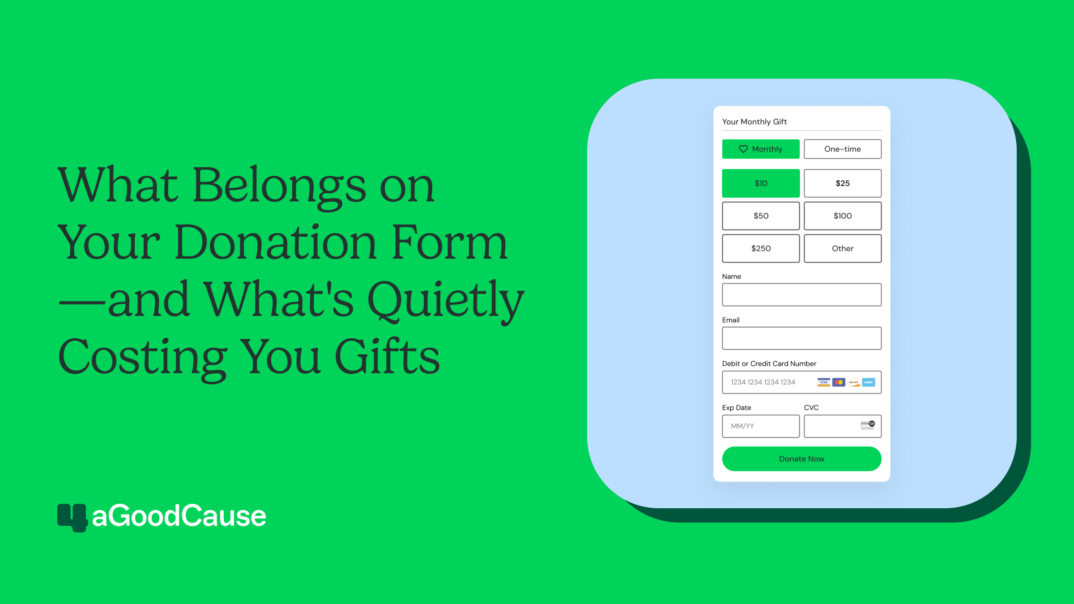
The essential fields: What is needed on a donation form?
Let’s start with the basics. When a donor lands on your giving form, the goal is simple: get them to complete the donation process with as little friction as possible. That means your required fields should only include what’s actually necessary to process the gift and send a meaningful follow-up.
Here’s what every nonprofit donation form genuinely needs:
Now let’s take a closer look at why each of these essential fields belongs on your donation form.
Raise more with the traffic you already have.
Donation pages on 4aGoodCause convert an average of 27% of visitors, compared to the 11% industry benchmark. Learn how Northwest Arkansas Circle of Life raised over $1M+ online (case study) and supported multiple fundraising channels with 4aGoodCause.
Donor’s name
First name and last name are essential. You need the donor’s name to personalize thank-you messages, maintain clean donor data in your CRM, and build a real relationship over time. That said, fields like “title” or “salutation” (Mr., Mrs., Dr.) are optional at best—skip them.
Email address
Email is the primary way you’ll follow up, send tax receipts, and stay connected with your donors. It’s non-negotiable. Phone number, however, is a different story—more on that in a moment.
Gift amount
Your donation form should make it easy for donors to choose their gift amount. Offer suggested donation amounts (giving levels) that reflect what a meaningful gift looks like for your mission, plus a custom amount option for donors who want to give something different.
If you’re running a recurring giving program, your giving options should also include a clear path to set up a recurring gift.
⭐️ Want an easier way to maximize donations? Monthly giving generates 2.4x more revenue on average than one-time gifts, and our Monthly Giving Toolkit can help you get started. You can also learn more through our resources on the benefits of monthly giving for nonprofits and how to retain monthly donors.
Payment information
Your giving form should accept credit cards and debit cards at minimum. Offering additional payment methods—like ACH bank transfers or PayPal—can reduce friction for donors who prefer those options. Whatever payment processor you use (Stripe, Authorize.net, or a built-in option like 4aGC payments), make sure your form is PCI-compliant and clearly signals that their payment details are secure.
💡 Fun fact: All donor tips through 4aGoodCause go directly to your organization—not the platform. Learn what makes 4aGC different than other fundraising platforms, and explore our guide to monthly donation forms for nonprofits for more ideas on creating a stronger giving experience.
A recurring gift option
If your nonprofit doesn’t have a monthly giving program yet, this is your sign to start. A simple toggle that lets donors convert a one-time donation into a recurring donation is one of the highest-leverage things you can add to your giving form. Monthly donors have an average retention rate of 83.6%—compared to just 45.2% for one-time donors—and they give significantly more over time.