Fundraising Ideas for Community Radio: Creative Events + Monthly Giving
Better fundraising ideas for community radio stations
Running a small, listener-supported community radio station can often feel like a never-ending cycle of fundraising events to stay afloat.
With traditional fundraisers like raffles, public radio share-a-thons, or trying to sell tickets to your next community talent show or annual gala, this work can produce burnout on your team.
If you’ve spent any time around public radio, you already know that a public radio fundraiser usually means a pledge drive: an on-air campaign that pauses regular programming several times an hour to ask listeners for financial support. Most stations run two or three a year, and the breaks keep coming until the station hits its stated goal.
Those drives pay for more than the week’s bills. At NPR member stations and across public media, for example, money raised during local breaks stays local, like funding the community programming, regional reporting, and emergency alerts your listeners count on. And during a drive, stations often lean on two options: thank-you gifts (the tote bags, books, and bonus podcast access donors know as “premiums”), and a push to get listeners to become a member at the sustaining level.
That second option is the one worth building your year around. Public radio calls it a sustaining membership, and the listeners who sign up are sustainers. While one-time donations cover a moment, sustaining gifts can support a budget longer term.
But even after all that effort, your budget can still remain unpredictable.
That unpredictability isn’t in your head, and it isn’t only your station. Every public media nonprofit in the 2026 M+R Benchmarks Study received less federal funding in 2025 than it did the year before.
Listeners largely stepped up. Online revenue for public media rose 37% on average in 2025, tied for the biggest year-over-year jump of any sector M+R tracked. But that support arrived as a surge, not a subscription. Public media’s monthly giving revenue grew a steadier 21% over the same period, and that’s information you can really build a budget on.
Public radio fundraising is constant hard work, but it doesn’t have to be this way. With the right strategy, your fundraising efforts can feel easier, more sustainable, and more effective. This guide shares:
In fact, many nonprofit organizations, including small community radio stations, are turning to one of the best fundraising ideas out there: monthly giving. (I’ll cover that in this guide.)
Let’s transform your one-off asks and annual fun runs into more reliable, sustainable fundraising, shall we?
Raise more. Stress less.
Join our newsletter and grab your free Nonprofit Growth Kit—real tools, real stories, and advice that actually works.
5 creative fundraising ideas for local radio stations
You’re already familiar with classic walk-a-thons, P2P crowdfunding, and annual campaign outreach via direct mail. What if you tried something different?
Below, we’ve got 5 fresh new fundraising event ideas.
However, later in this article, I’ll discuss how and why to pair a monthly giving program with classic fundraising tactics like annual events or end-of-year giving campaigns.
Make fundraising part of the show with dedicated live segments where DJs become your fundraising leaders:
Let DJs share stories, listener testimonials, and progress toward goals on-air.
Offer raffle tickets or perks for any donations called in or made online through the Donate Now button on your campaign page.
Mix live pitching with pre-produced spots: a few recorded listener stories, cut with music, give your DJs something to lean on when the energy dips.
Promote the event via your fundraising page, donation pages, and/or social media, and ask your hosts and most devoted listeners to run their own peer-to-peer pages alongside the drive.
This event is similar to a quarterly share-a-thon, but instead of putting a larger quarterly event on every few months, your station DJs weave in a few dedicated fundraising hours a week, dispersed across peak listening times, so these asks are fully incorporated into your routine.
If your radio station is known for platforming local bands and independent musicians, invite local musicians to compete in a fun, low-cost event:
Charge an entry fee for bands and sell tickets to attendees.
Partner with local restaurants, food trucks, or a concession stand for refreshments, and invite a local business to become a sponsor of the stage.
Use the parking lot of a community center, high school, or local park.
If or when you have a monthly giving program in place, you’ll want to include a booth or table at live events (like this one!) with signage about your recurring giving program or a text-to-donate option to join.
Perhaps you offer an incentive for new monthly giving program members like this: Any attendee who joins the program that night doesn’t have to pay the admittance fee.
3. Trivia-a-thon or music-themed contest
Host a trivia night (in-person at a local restaurant or bar or host virtual events) featuring questions about the local community, core topics that matter to your station and your audience, or music:
Encourage community groups to form teams.
Offer small prizes, station t-shirts, or shout-outs.
Livestream the event on your station and across social media.
For example, if you’re a public radio station that reports on local regional news and politics—along with events that matter to the community, like local college sports leagues—perhaps you host a night that centers on amusing trivia from the most entertaining stories and moments from the last year.
“
I have watched our monthly giving grow as 4aGC has made consistent incremental improvements to our donors' giving experience, and added helpful back-end tools for me and my staff.
David Hunter
Development Director at WBOI
4. “Audio mystery hunt” fundraiser
Host a citywide scavenger hunt powered by audio clues aired live or via podcast format—like a radio drama meets community escape room.
Over a weekend, teams sign up (with an entry fee).
Clues are embedded in short, radio-play-style segments aired on your station or posted online at certain times.
Each clue leads participants to landmarks, local businesses, or quirky community spots.
Finishers get swag (like station t-shirts, or merch carrying a local in-joke rather than just your logo — people wear those) and entry into a final raffle or silent auction.
This particular fundraising event would pair well with partnerships or sponsorships from local businesses. Consider pairing an event like this with a matching gift incentive with a local business, board member, or larger sponsor.
5. “Swap the airwaves” challenge
Let a guest host (like a local mayor, teacher, or business owner) take over your station’s airwaves—for a price.
List 10+ “airwave takeover” slots on your fundraising page.
Each slot can be sponsored with a minimum donation (e.g., $250).
Sponsors pick the theme (within guidelines), bring their playlist or stories, and “host” an hour (with station support).
Promote each takeover heavily on social media and on-air to drive more curiosity—and future sponsors.
If and when you have a monthly giving program established, build exclusive benefits around it: behind-the-scenes content from a “swap the airwaves” challenge, or a vote on which guest host gets the next slot.
“
Two weeks in from when we went live on air with [4aGC], we got it up and running, and people were definitely taking advantage of it. I was like ‘Wow, this is robust.’
Dave Andrews
Station Manager at KJOL
How to avoid the one-off fundraiser burnout cycle
For many community radio stations, fundraising has long meant a string of isolated events and biannual direct mail campaigns: the annual raffle, the once-a-year fundraising gala, or the midyear giving push.
These require weeks of planning, massive volunteer support, and endless social media promotion—only to be followed by long gaps in funding and momentum.
In my work with nonprofits, I see it all the time:
A well-intentioned email fundraising campaign or trivia night led by volunteers
A flurry of outreach on-air and online
One big push … then quiet, until the next big fundraising event
That stop-and-go cycle takes a toll.
It wears down volunteers, creates financial stress, and makes long-term planning hard.
Just ask Dave Andrews, General Manager of KJOL, a local nonprofit radio station in Colorado.
For KJOL, switching to 4aGoodCause’s user-friendly fundraising platform helped them grow from just 13 monthly donors to more than 70.
“We saw a huge jump in monthly giving.” — Dave Andrews, KJOL General Manager
KJOL’s approach included:
Live on-air mentions of their campaign
A simplified donation experience via mobile and desktop
A clear mission to build recurring revenue
Before switching to a monthly giving strategy, Dave and his team relied heavily on seasonal drives. That shift made a world of difference.
“Probably within a month, we had done four times what we were getting before,” Dave shared.
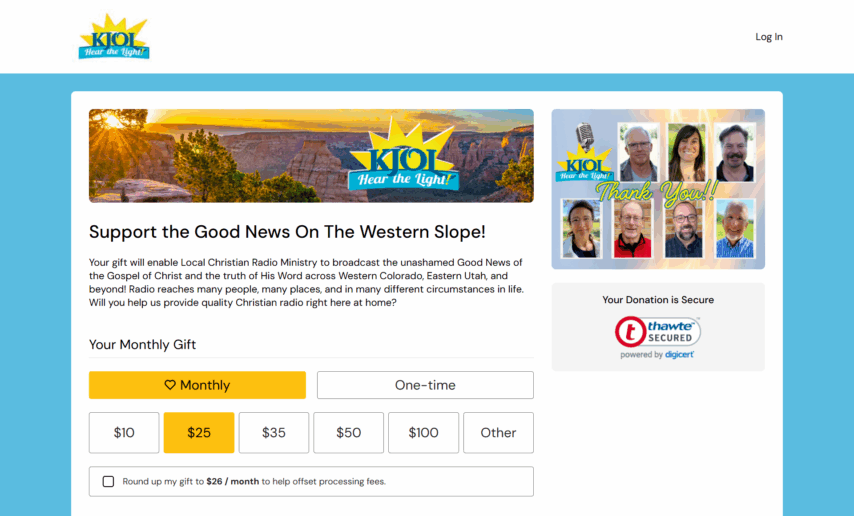
KJOL donation page
By introducing recurring gifts and simplifying the donation process, KJOL grew its monthly donors in multiples.
Within weeks, their income was significantly more stable.
“
What is the best price, with the most features, with the least work, and the best service? That’s 4aGoodCause for us.
Dave Andrews
Station Manager at KJOL
And with less time spent chasing one-off donations, Dave’s small team was able to reduce administrative burdens and spend more time engaging with their community members and improving content.
“We don’t want to guilt people into donating,” he emphasized. “We want something that comes from the heart. We try to have a very guilt-free experience for our listeners, and make it fun, too.”
By leaning into monthly giving, KJOL avoided the burnout cycle and created a fundraising engine that now runs year-round—with fewer urgent appeals, and a lot more joy.
🤯Did you know?You don’t need to work harder to raise more. The average monthly donor gives $660 per year with the 4aGoodCause platform. Learn how the 4aGC Monthly Giving Toolkit helps you build a loyal base of recurring donors who are passionate about your cause.
Why monthly giving solves radio station fundraising challenges
Monthly giving programs are resulting in revenue success (and increased stability) across the nonprofit world, and nonprofit radio stations can also benefit from this fundraising strategy.
Even $10/month from loyal listeners can fuel fundraising goals year-round—from new gear to expanded local shows.
We’ve found that 4aGoodCause’s monthly giving average is $55 per month. That’s roughly double the $28 industry benchmark. And monthly giving now accounts for 27% of all online revenue across the nonprofits in the 2026 M+R Benchmarks Study; 22% for the smallest organizations.
How much can you earn?
How much can you earn?
$
Total raised for your organization
Less pressure on volunteers and staff
When your base of monthly donors grows, you can reduce the number of classic and time-intensive fundraising activities (like the age-old Gala).
Sustainers also stay in a way one-time donors don’t. The 2026 M+R Benchmarks Study found 81% of monthly gifts still active after seven months, 71% after a full year, and a little more than half still going after two full years. And 4aGoodCause makes donor retention simple—and upgrading monthly givers over time very easy.
Monthly donors tend to stick around longer, stay more engaged, and help promote your fundraising campaign through social media and word-of-mouth.
In fact, the 2026 M+R Benchmarks Study found that donors who gave only one-time gifts online averaged $183 in annual revenue apiece. On 4aGoodCause, the average monthly donor gives about $660 a year (and you don’t have to re-earn the gift every time).
⭐️ Ready for consistent donations with less planning hassle? Monthly givers stay: roughly seven in ten monthly gifts are still active a year later (2026 M+R Benchmarks). Discover how 4aGoodCause helps you build a loyal base of recurring donors who are passionate about your cause.
7 top fundraising tips for DJs hosting fundraisers on-air
Whether you’re taking the classic fundraising approach or are including monthly giving as part of your overall strategy, here are a few tips for DJs who are taking the lead with on-air fundraising:
🤯 Did you know?The 4aGoodCause platform makes giving effortless for your donors (and you). Your stories inspire the giving, but we make fundraising easy with the right tech. See it for yourself.
Frame yourself as a community member, not a salesperson
Authenticity builds trust. Be transparent about why the station needs support and how listener contributions make a real difference.
Tell emotional, impactful stories
Share listener narratives: how the radio helped them, created connections, or brought joy. These human‑interest moments prompt more engagement.
Pre-record humorous or heartwarming audio ads with music beds and sound effects—they’re more polished and effective than spontaneous appeal breaks.
Set clear goals and give progress updates
Let listeners know exactly what you’re raising funds for (e.g., new transmitter, signal boost, community programming). Show progress with live updates and read new donor names on-air with permission.
“
We are a small nonprofit with minimal staff so a platform like 4aGoodCause has provided us with a professional, streamlined system for online donations. Our rep is amazing and always responsive when we have questions or need assistance. I would highly recommend this platform!
Melanie R Carroll,
Executive Director at Angel Flight SC
Integrate social media and on‑site events
Stream parts of the fundraiser live, post reminders, and involve event partners to amplify appeal both on radio and online.
Communicate purpose clearly
Share not just the “why,” but the defined goal—“$25,000 for studio upgrades,” “$5,000 for expanded local shows”—aligning donor impact with tangible outcomes.
Acknowledge and follow-up promptly
After the drive, send personalized thank-you messages and share results: “We hit $30K—enough to upgrade our transmitter and add two new community programs!”
Fundraising software that feels like part of your team.
A few FAQs about fundraising for small public radio stations
Beyond monthly giving, what other ways to give should a station offer?
Most listener-supported stations are registered 501(c)(3) nonprofit organizations, which means listener gifts are tax-deductible and a handful of other giving paths open up. The ones worth listing on your ways to give page:
One-time and annual gifts. The classic drive gift, plus a year-end ask.
Sustaining membership. A recurring monthly gift: your most predictable revenue, and the reason this guide exists.
Donor advised funds. A donor recommends a grant from a DAF they’ve already funded. Gifts through donor advised funds tend to run large; on 4aGoodCause they average $2,325.60.
Qualified charitable distributions. Donors 70½ and older can give straight from an IRA. You’ll also hear this called an IRA charitable rollover, and a QCD can satisfy a required minimum distribution.
Planned giving. A planned gift or legacy gift named in a will or estate plan. Slow to mature, but it costs almost nothing to mention on air.
Vehicle donation. Many stations work with a third-party service so a listener can donate a vehicle they no longer drive. You publish a “donate your vehicle” link; the partner handles pickup, title, and resale.
Major gifts and a leadership circle. A named giving society with exclusive benefits (studio invitations, early event access) for your largest annual gifts.
You don’t need all of these on day one, and a two-person station shouldn’t try. Start with the two that fund your next twelve months — monthly giving and one-time donations — and add the rest as capacity allows. Publishing an annual report alongside them helps donors at every level see where their money actually went.
How much of a listener’s gift actually reaches the station?
Less than most listeners assume, and it depends on your platform. Every online gift carries a payment processing fee from your card processor. On top of that, some platforms add a percentage of their own, and some prompt your donor for a tip that goes to the software company rather than to you. A $50 gift can arrive noticeably lighter than $50.
It’s worth being able to answer this plainly when a listener calls in and asks. If you can’t, that’s usually a sign it’s time to read your platform’s fee schedule closely.
💡 Fun fact:All donor tips through 4aGoodCause go directly to your organization—not the platform.
Next steps: Here’s your quick-start checklist to raise more and stress less
Monthly giving doesn’t mean replacing your fundraising efforts altogether—but it does create a solid base that powers your creative fundraising year-round.
And with 4aGoodCause’s streamlined monthly giving platform, starting and growing a recurring giving program is easier than you think. Get a demo.
Script your on-air pitches and gather testimonials from existing donors and volunteers.
Develop gift tiers and rewards: t-shirts, shout-outs, exclusive content.
Promote via social media, email, and events.
Watch your monthly giving program members grow, and use 4aGoodCause’s tools to upgrade monthly givers over time with the Monthly Giving Toolkit.
With monthly giving as your core strategy, every contestant, community partner, or friendly competition you host becomes an opportunity to grow a stable, engaged donor base.
Want help launching or optimizing your monthly giving program?
Reach out today—or start building your next successful fundraising effort for your good cause!
Ronald is the President and Founder of 4aGoodCause, the fundraising CRM that makes recurring, monthly giving a breeze for small nonprofits.
For over 25 years, Ronald has had the joy of doing what he loves, building online solutions that make a difference in the world. He’s helped raise millions of dollars online for small nonprofits across the country. Connect with Ronald on LinkedIn.
Grow your monthly giving program with our resources