How to Retain Your P2P Donors: Convert Them to Monthly Givers
Peer-to-peer (P2P) fundraising is powerful because it starts with people.
When a supporter creates a campaign page, shares it on social media, and invites their friends to give, they’re putting their heart behind your mission.
That kind of personal outreach brings in new donors who may never have heard of your nonprofit otherwise.
But once the P2P campaign is done, what do you do with all that momentum?
And how do you convert your P2P fundraisers (or first-time donors who give through a P2P campaign) into sustainable revenue for your org?
There’s obviously an opportunity here. Those fundraisers—and their donors—aren’t just “one-and-done” participants.
They’ve already shown they believe in your work and are willing to advocate for it and support it.
With a little strategic follow-up, they can become some of your most loyal monthly donors. And I’ll give you a step-by-step plan (with a helpful template) in order to help you do this.
You’ll cover the following in this guide, but feel free to use the links below to skip ahead:
Get fresh, encouraging education + industry-leading tips for nonprofit teams.
The case for conversion: Data and donor retention
Think about it: while one-time gifts are wonderful, they can make your revenue feel unpredictable—like you’re always waiting for the next fundraising event or appeal.
A monthly giving program changes that.
Recurring donations provide steady, reliable support you can count on, helping you plan ahead and fund programs year-round.
That’s why you can’t overlook the fact that P2P campaigns can be a natural doorway into monthly giving.
Monthly giving isn’t just the future of sustainable fundraising—it’s the key to building a community of supporters who stay with you, month after month, because they truly care.
Plus, the retention numbers for monthly givers are just as striking.
On average, only about 23% of new one-time donors give again the following year.
Compare that to recurring donors: roughly 77–80% continue their support year after year.
That’s a powerful difference—especially when you think about how much time, effort, and money it takes to find new donors.
Let’s look at an example to better illustrate those numbers.
📚Did you know? “Free” fundraising software can cost you (and your donors) a ton. Our team completed a full comprehensive analysis: The Real Cost of Free Fundraising Software.
Example: P2P participant conversion to monthly giving
I’m going to use my favorite fictional charity in this example: 🦇Bruce Wayne’s Bat Sanctuary.🦇
Let’s say you and your team at the bat sanctuary run an annual P2P campaign challenge: A walkathon where each walker creates their own personal fundraising page and asks friends, family, and coworkers to sponsor them with donations for completing the walk. (Pretty standard!)
This year, you have 55 walkers sign up who are peer-to-peer fundraising. You also have 143 signups for walkers who aren’t participating as fundraisers.
On average, each of your 55 P2P fundraisers have 25 supporting people donate to their fundraising goal.
That’s 1375 donors from the P2P challenge.
Let’s say you use a comprehensive plan to encourage participation in the monthly giving program, and you’re able to convert 137 of those supporting donors to monthly givers. (Go team!)
“
Working with 4aGC has been great! I would highly recommend. Our online monthly donations have gone up 300% since we started working with them. They listen to feedback and ideas and even implement them. Tech support has been breezy and prompt. It's the personal touch that sets them apart from the rest.
David Andrews
KJOL
If all those supporting donors joined the Bruce Wayne’s Bat Sanctuary monthly giving program at $10 a month—in addition to their donation pledges for the walkathon—that’s an additional $16,440 per year for the Bat Sanctuary.
If you retain about 75% of those monthly givers, that’s 102 recurring donors that will remain with you next year.
But great news: You run a successful walk-a-thon every year.
And the following year, you end up gaining an additional 142 monthly givers from your conversion strategy plan (the one that worked so well the year before, too!).
You now have 244 recurring monthly givers. And if they all average out to giving about $10 a month, that’s $29,280 per year.
Here’s the bottom line: Retention-focused fundraising isn’t about giving up on acquisition. It’s about balance.
So doing the work to convert your P2P fundraisers and their donors into monthly givers is absolutely worth the effort.
I’m going to walk you through a tactical approach to a donor engagement strategy that can help make it all happen.
👇👇See how much your organization could raise with monthly giving. 👇👇
How much can you earn?
$
Total raised for your organization
A campaign-ready conversion plan for turning P2P fundraisers into monthly donors
Most advice on converting peer-to-peer (P2P) fundraisers into monthly donors stops at generic tips.
What you need is a framework you can pick up and use right away.
I’ve created a simple plan your team can adapt, no matter the size of your nonprofit.
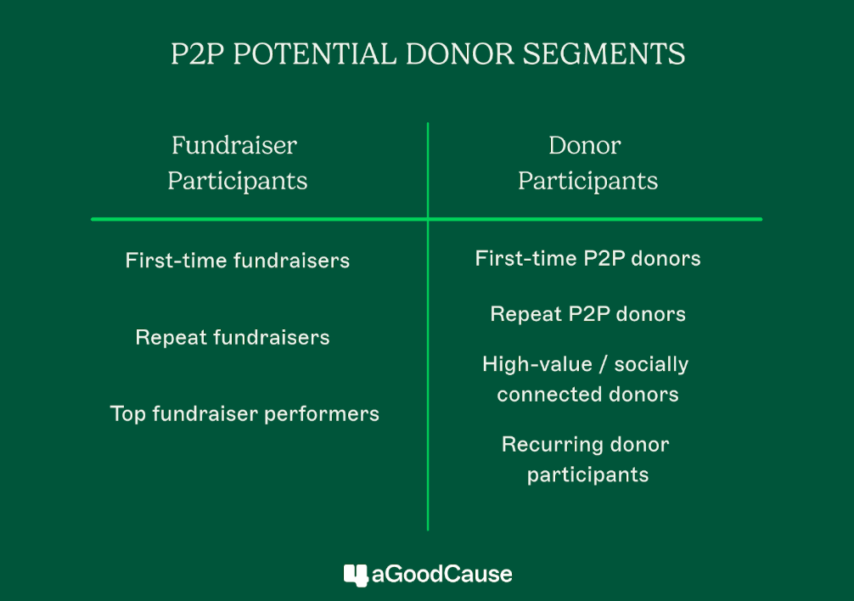
And if this big list feels overwhelming, just rest easy knowing that doing the actual donor segmentation for these groups within 4aGoodCause is simple and straightforward.
Nonprofit software that feels like part of your team.
Who they are: New to your cause, raised small amounts
Conversion angle: Emphasize the impact of sustaining their “first step”
Example ask: “Your first fundraiser helped one family. $10/month helps a new family every single month.”
Repeat fundraisers
Who they are: Come back for annual runs, rides, or campaigns
Conversion angle: Highlight community and long-term impact
Example ask: “You’ve shown up every year. Join our Giving Circle to make your support felt every day.”
Top fundraiser performers
Who they are: Raised the most money, strong networks
Conversion angle: Treat them as ambassadors and leaders
Example ask: “You’ve inspired dozens of donors already. Imagine the ripple effect of your ongoing gift.”
First-time P2P donors
Who they are: Gave for the first time through a friend’s fundraiser or challenge.
Conversion angle: Emphasize that their gift made a real impact and invite them to “keep the good going” with a simple monthly contribution.
Example ask: “Your donation gave a child one safe night of shelter. $15/month ensures that safety all year long.”
Repeat P2P donors
Who they are: Have donated to multiple P2P campaigns (same friend each year or different friends).
Conversion angle: Position monthly giving as a way to consolidate their generosity into a single, steady stream of support.
Example ask: “You’ve supported us again and again through your friends’ fundraisers. A monthly gift makes sure your generosity is felt every month, not just once a year.”
High-value / Socially connected donors
Who they are: Donated larger amounts during campaigns or consistently sponsor multiple fundraisers.
Conversion angle: Elevate them as impact partners—show how their leadership through monthly giving inspires both fundraisers and fellow donors.
Example ask: “Your gift inspired others to join. As a monthly donor, you can lead the way in sustaining change.”
Recurring donor participants
Who they are: Already on a monthly giving plan and still join P2P challenges.
Conversion angle: Reinforce loyalty, deepen the relationship, and encourage them to invite their friends into monthly giving too.
Example ask: “Thank you for being both a fundraiser and a monthly donor! Would you share your monthly giving story so more supporters can join you?”
When I say “message archetype” here, I mean a repeatable messaging or framing pattern you can apply across your communications.
Instead of writing a brand-new ask every time, you can develop 2–3 core storylines that you rotate.
Each archetype speaks to a different donor motivation.
And if you have an excellent community manager like they do over at Foothills Animal Shelter (one of our 4aGoodCause clients!) who takes on donor management and relationship responsibilities for 400+ recurring givers, it’s likely that team member will have some great insight in which messaging archetype fits for specific donor segments.
The most important thing to keep in mind? Rotate your messages so you don’t sound repetitive—and make sure that the right messaging goes to the right donor segment.
Below, I’ve provided three messaging archetypes for your P2P-to-monthly-donor conversion strategy. But feel free to make these your own or get creative with additional options.
Impact archetype
For this messaging framework, you’re going to focus on long-term impact and concrete results.
The core angle is something like “Your one-time action had a big impact. A monthly gift multiplies that impact.”
Why it works: This approach appeals to outcome-driven donors who want to see tangible results
Example: “Your fundraiser gave one child a safe night of shelter. $15/month makes that safety possible every month.”
“
As a small and growing nonprofit, we need a fundraising platform that serves not only our budgetary needs but also provides a seamless experience for our donors AND for us as well. 4aGC checks ALL the boxes. Excellent product and the best customer care around! Highly recommend!
Kelly Mellen
Managing Director, Making Things Right
Community archetype
For this framing, we’re centering on social effects and community belonging.
Your core angle will reflect that. It might sound like this: “You’re part of a movement. Joining monthly giving connects you with others like you.”
Why it works: The community archetype appeals to donors who value belonging, recognition, or social proof.
Example: “Dozens of fundraisers have stepped into our Giving Circle. Will you join them?”
Convenience archetype
Here, your core message is making meaningful, impactful generosity easier than ever, using sentiments like “Monthly giving is the easiest way to keep supporting what you care about.”
Why it works: This messaging appeals to donors who value simplicity and a “set it and forget it” approach.
Example: “Monthly giving lets you continue your support automatically—no need to sign up again next year.”
There could be a few different messaging archetypes you come up with for your organization.
And by naming archetypes, you have a practical toolkit you’ll have on hand and can cycle through—making your mail and email marketing messaging systematic, not ad hoc.
Keep in mind, you can use these archetypes throughout regular updates for your recurring giving programs, when you introduce new initiatives or marking big milestones, and to incorporate into other communication and fundraising efforts—not just this one.
Implementing your plan isn’t just about launching a strategy to convert your P2P fundraisers into recurring givers.
You also need to measure what’s working—that way, you can replicate the same plan in the future or optimize it over time.
Tracking your results doesn’t have to be complicated. You can start off by keeping it simple:
P2P campaign thank-you email metrics to track: Here, you’re going to want to monitor the open rate. Aim for 45–60% for a solid benchmark.
P2P campaign monthly-gift ask metrics to track: Monitor the click-through rate for any monthly donation asks in your follow-up email campaign. Aim for 5-10%.
Conversion metrics to track: You’ll want to record the percentage of P2P fundraisers (and their P2P campaign donors) who sign up for recurring gifts. A healthy conversion rate would be 3-5% of the total group.
Retention metrics to track: Analyze how many monthly donors who sign up during this campaign are still active 12 months later. Aim for 75-80%.
If your monthly giver retention rate is lower than 75%, it might be a sign you need to invest more in donor relationships or into a unique giving experience that includes bonuses for those in the monthly giving program.
⭐️What if you could do big asks less often?There is a way! It’s called recurring monthly giving, and it generates 2.4X more revenue on average than one-time gifts. This Monthly Giving Toolkit simplifies the whole program. Learn more.
Here’s a quick example of what a small ask could look like:
Your $10/month has provided 60 meals. Would you consider $15/month to cover a family’s groceries for a week?
On their one-year donor anniversary, you could also celebrate them with a personalized thank-you and a reminder of how far they’ve come since their P2P fundraiser.
Ultimately, with this simple plan, you’re creating a structured journey that respects the donor’s first step as a fundraiser and builds a pathway into long-term giving.
Optimizing your fundraising tools and processes
If this all sounds like a lot of work, well, you’re right!
But with the right templates, tools, and processes, you can simplify the P2P-to-monthly-donor acquisition process.
The way you set up your fundraising pages (and even the landing page for the P2P campaign or event) can make the difference between a one-time donor and a recurring supporter.
⚠️ Important note: Beautiful, customized nonprofit fundraising pages are made easy with 4aGC. Plus, donor tips are optional and your organization keeps them all—not us. Learn more about how 4aGC can help you raise more while stressing less.
If you want peer-to-peer participants to become monthly givers, you need to start by making the process as simple and inviting as possible.
Donation forms and pages: Build your primary landing pages and donation pages for your P2P campaigns to also showcase the impact of recurring gifts, and consider making “monthly” the default option on your form. Even small nudges—like highlighting what a $10 or $15 monthly gift accomplishes—can help your potential donors picture their ongoing impact.
User-friendly giving: The easier the experience (and the more payment options your donors have), the more likely someone will say yes. A streamlined fundraising platform with mobile-friendly fundraising tools keeps the whole process stress-free.
Connected systems: Make sure your CRM, email marketing tools, and fundraising platform talk to each other. When your systems are integrated, you’ll have better donor data to track who gave, what motivated them, and when to follow up. That insight makes your outreach more personal—and more effective. (And with 4aGoodCause, you can also segment donors using tags, and if you use Mailchimp, those segments also apply to your email sends.)
Thoughtful follow-up: Once the gift is made, your job isn’t over. Keep supporters connected with regular updates, celebrate milestones, and invest in simple acts of donor stewardship like thank-you notes or quick check-in emails. Donors want to know they’re part of a bigger story; your consistent communication shows them just how much they matter.
Raise more and stress less with 4aGC
Peer-to-peer campaigns are powerful launchpads.
They bring in new faces, spark energy around your cause, and create moments of connection.
And with the right follow-up strategy in place, you can channel that momentum into your monthly giving program—turning one-time fundraisers into long-term partners.
When first-time donors and P2P campaign participants commit to a monthly gift, they’re not just helping you meet today’s goal, they’re also building toward the stability of your org long-term.
That steady support creates a sense of community, strengthens donor loyalty, and helps your nonprofit weather the ups and downs of event-driven revenue.
But the shift toward monthly giving makes a huge difference for you and your team, too. It transforms fundraising from a year-round cycle of chasing the next event into the kind of sustainability that means less stress for your staff and board.
At 4aGoodCause, we make it easy to bridge the gap between peer-to-peer fundraising and ongoing support.
From donation forms that can optionally default to recurring gifts to easy, DIY fundraising pages for one-off campaigns, our platform is designed to help you build lasting donor relationships—no tech knowledge required.
👉 Ready to find out how to simplify your fundraising and amplify your impact? Get started with 4aGoodCause. I’ll show you how easy it is myself!
Ronald is the President and Founder of 4aGoodCause, the fundraising CRM that makes recurring, monthly giving a breeze for small nonprofits.
For over 25 years, Ronald has had the joy of doing what he loves, building online solutions that make a difference in the world. He’s helped raise millions of dollars online for small nonprofits across the country. Connect with Ronald on LinkedIn.
Grow your monthly giving program with our resources