Donor Retention Rate: 2026 Benchmarks, a Free Calculator, and How to Keep More Donors
If you’ve ever wondered why some donors give once and disappear while others stick around for years, you’re not alone.
Retaining donors is one of the biggest challenges nonprofits face, but it’s also one of the biggest opportunities.
Understanding your donor retention rate helps you not only measure your success, but it also uncovers ways to build stronger, lasting relationships with your supporters.
Simply put, your donor retention rate is the percentage of donors who give to your organization year over year.
Donor retention is one of the most important fundraising metrics you can track. Treat it as a core KPI alongside fundraising revenue and donor churn, and revisit it in a simple retention report each quarter so trends are easy to spot.
The higher the retention rate, the more donors you have that continue to support your nonprofit each year.
The lower the retention rate, the harder you may have to work to get those donations in the door again (or attract new donors).
💡 Built-in benchmarking: With real-time retention data built right into your 4aGoodCause dashboard, you can monitor donor loyalty and spot changes early—no spreadsheets, just insights that help you strengthen relationships and sustain giving.
Calculating your donor retention rate: The essential formula
To understand your starting point, you first need to accurately calculate your own donor retention rate.
Good news: This is one of the simplest calculations you’ll ever do in fundraising!
This isn’t complex math; it’s a straightforward formula that provides invaluable insight.
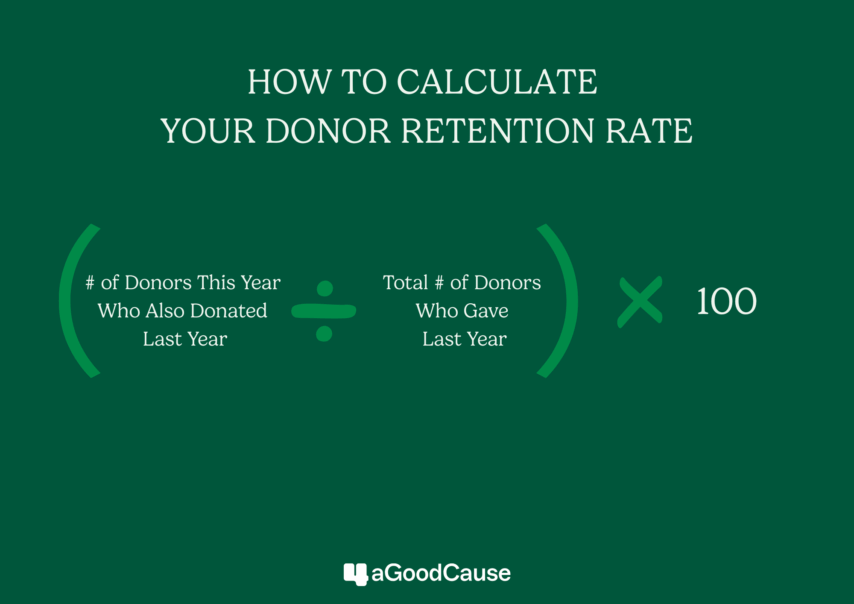
Here’s how you calculate it:
(Number of Donors in Current Year Who Also Donated in Previous Year / Total Number of Donors in Previous Year) x 100 = Donor Retention Rate (%)
Let’s break that down with an example:
Previous Year (e.g., 2022): You had 1,000 donors.
Current Year (e.g., 2023): 600 of those 1,000 donors made another gift.
Calculation: (600 / 1,000) x 100 = 60%
Your donor retention rate for this example is 60%. In plain terms, the donor retention rate formula compares the number of donors last year with how many of them gave again this year.
This calculation provides a powerful baseline. Use it. Understand it.
It’s the foundation of your retention strategy!
What are we really measuring with a donor retention rate?
Your donor retention rate shows how well you’re building two things:
Loyalty
Engagement
Why is this so crucial?
Because it costs a lot more to bring in a new donor than to keep an existing one.
If you compare your retention metrics to last year, you’ll quickly see whether you’re improving or falling behind.
A strong retention rate is a signal of healthy donor relationships and proof that your mission resonates.
A lower rate may point to gaps in communication, stewardship, follow-up, impact reporting, or the types of donors targeted.
Donor retention rate calculator tool: How to use
Here, I’ve created a simple calculator you can use to calculate your donor retention rate and estimate how much more you could raise with modest retention gains. Because it’s an interactive tool—not just a formula—it does the math on your exact numbers in seconds, something a search result alone can’t do for you.
Simply add in the numbers you want to crunch—including your number of donors that gave last year, how many of those have returned this to give this year, your average gift size, and the tool will take care of the work for you.
And don’t worry, everything you input here stays private to you and your organization. 4aGC doesn’t save or track this data.
💡Real-time donor insights: See your retention performance in real time, right from your dashboard. 4aGoodCause updates your 12-month rolling rates automatically so you can quickly spot trends and take action.
Donor Retention Calculator
Current donor retention benchmarks for 2026
Now that you know how to calculate your own rate, it’s time to know the industry benchmarks.
Overall online donors retention rates: 48% on average
New online donors retention rates: 24% on average
Prior online donor retention rates: 66% on average
You can also compare figures to the annual Fundraising Effectiveness Project (FEP) report, (a collaboration between the Association of Fundraising Professionals and the Center on Nonprofits and Philanthropy at the Urban Institute), whch offers an essential perspective on the state of philanthropy:
Overall donor retention rates benchmark: 42.9% on average
New donor retention rates: 19.4% on average
Repeat donor retention rates: 69.2% on average (with recurring monthly givers having retention rates up to 90%).
The FEP has a running Retention Rate by Donor Type report where you can compare the YTD industry average to your own organization.
🤯Did you know? You don’t need to work harder to raise more. The average monthly donor gives $660 per year with the 4aGoodCause platform. Learn how the 4aGC Monthly Giving Toolkit helps you build a loyal base of recurring donors who are passionate about your cause.
Overall donor retention rates benchmark
The average donor retention rate has consistently hovered at around 40-45% for the last couple years, according to the FEP data. However, the M+R Benchmarks study shows 48% on average for repeat online donors (or retained donors).
What does this mean for your organization?
It means the industry standard is often to lose more donors than you keep.
This means that for every 100 donors an organization has this year, only about 40 will make a gift the next year, according to this industry average.
This low average isn’t a sign of failure; but it is an opportunity for growth.
Where do you stand compared to this national average? Are you above it, or below? Knowing this is critical.
New donor retention rates: The toughest challenge
First-time donors are the hardest to keep. Their loyalty is still forming. The average first-time donor retention rate was 24% on average according to the M+R report.
The average first-time donor retention rate was 19.4%, according to the FEP report.
This is exactly why a thoughtful onboarding strategy is so important.
How are you actively working to secure that second gift?
(Don’t worry—I’ve outlined some guidance to help increase your retention rates later in this article. So stay tuned.)
Repeat donor retention rates: Your gold standard
Repeat donors are your most loyal supporters. These are the individuals who have already demonstrated their commitment more than once, so their retention rates are usually significantly higher.
The average repeat donor retention rate from the 2026 M+R data was 66%, which has stayed about the same year-over-year when compared to the FEP report benchmarks over time.
For donors who have given more than once, their likelihood of giving again is dramatically higher. This segment represents your most valuable asset.
But here’s where retention rates get really interesting: Recurring monthly givers have yearly retention rates up to 90%.
This is huge.
Monthly giving programs are where your donor acquisition efforts yield the greatest return.
Creating a monthly giving program, nurturing these repeat donors, upgrading their giving over time, and keeping them deeply connected should be a top priority.
They aren’t just donors; they are advocates and long-term partners. Here’s a few highlights about monthly giving:
Average lifetime value (LTV) of a monthly donor: $7,604
Average yearly giving with the 4aGoodCause platform: $660
Average gift size on 4aGoodCause: $55/month (The M+R Benchmarks Study mentions the average recurring monthly donation for nonprofits is $28.)
That donor lifetime value (LTV) is exactly why monthly programs deserve special focus—every recurring donor you keep compounds for years.
🤯 Did you know?You can get consistent donations without the hassle. We help you build a loyal base of recurring donors who are passionate about your cause. Learn more about 4aGoodCause.
See how much you could raise with monthly giving!
How much can you earn?
$
Total raised for your organization
Benchmarking across different subsectors: Where do you stand?
Not all missions retain donors at the same rate. Benchmarks from across the nonprofit sector can show you roughly where your own fundraising efforts stand, but retention rates vary widely by subsector—and the retention patterns of large, national organizations often look very different from small, community-based nonprofits.
For the most current subsector picture, we can look at the 2026 M+R Benchmarks Study.
⚠️ Important note:The M+R data measures online donors only. A “new” donor here is someone who gave online in 2025 but not in any of the previous three years. So think of these as your online one-time donor retention benchmarks—not your all-channel rate. If a good share of your giving still comes through the mail or in person, your true, blended retention rate will look different from the numbers below. (This is also why these figures don’t perfectly match the all-channel FEP averages earlier in this article—they’re measuring different things.)
Across all causes, about half of online one-time donors (48%) who gave in one year came back to give again the next. But that average hides a big spread once you break it down by cause and by donor type—new donors versus prior (repeat) donors:
Remember that large national organizations (like the American Red Cross) face very different retention dynamics than small, local community groups. And depending on what’s happening across the sociopolitical spectrum, environmental causes might see different trends than arts organizations or health charities in any given year.
So use these benchmarks as a starting point, not a verdict. If you can, talk with other nonprofit pros in your subsector and local community to compare notes. Ask questions like:
What are your average donor retention rates for different types of donors?
Where do your retention rates differ from the benchmarks?
What donor retention strategies have they found most successful?
Then use those benchmarks—and your own numbers—to set realistic goals and build a plan that increases donor retention in your specific community.
Knowing your numbers is step one. Understanding why donors lapse is step two.
Most lapses aren’t sudden, they’re the result of gradual disengagement.
It’s rarely about a sudden change of heart; more often, it’s a gradual drift caused by a few factors.
Some of those factors are internal (like retention efforts) while some are external (like economic or political climate).
What are you doing, or not doing, that can move the lever on retention?
Analyzing donor data can reveal patterns in donor behavior, such as when and why donors lapse.
Sometimes it’s because of things inside your control—like how you communicate or follow up.
Other times, it’s due to outside factors like changes in the economy or community.
Let’s take a closer look at both, the internal and external factors for donor lapse.
Internal reasons:
Lack of meaningful communication: Donors don’t just want to be asked for money. They want to know their previous gift made a difference. If you only reach out when you need funds, you’re missing a huge opportunity for engagement.
Failure to demonstrate impact: Did their last gift actually achieve something? If you don’t show them the tangible results of their generosity, why would they give again? Specificity matters here.
Poor stewardship: This goes beyond a simple “thank you.” Stewardship is a continuous process of appreciation, relationship-building, and demonstrating value. Are your thank yous personalized? Are they timely?
Over-solicitation: Constantly hitting donors with appeals without sufficient “love” (stewardship, updates, impact reports) in between can lead to fatigue and alienation. Find the right balance.
Lack of personalization: Treating every donor the same is a recipe for disengagement. Donors want to feel seen and valued as individuals, not just as numbers on a mailing list. Sharing real impact stories is one of the best ways to remind donors that their gift matters.
Negative experience: A poorly managed donation process, a rude interaction, or a failure to update contact information can all lead to a lapsed donor. Every touchpoint matters.Even small details, like a clunky checkout page, affect the donor experience and future giving.
“
4aGoodCause has truly been a huge blessing to us at Tumaini DC. As a coach supporting several small nonprofit organizations through my IMPACTpreneur University coaching and mentorship program, I always make it a point to share 4aGoodCause with all of our members—it’s a game-changer.
Portia Richardson
Founder & Executive Director, Tumaini DC
External reasons:
Changes in your local community: Donor priorities may shift if local needs evolve. For example, a community crisis or the rise of another urgent cause can redirect attention and giving.
Political changes: Shifts in policy or legislation can affect both nonprofit funding and donor confidence. Some donors may pull back during uncertain times or redirect their giving toward advocacy-based organizations.
Economic changes: Inflation, job losses, or broader economic downturns can reduce disposable income. Even loyal donors may need to pause or scale back their giving during these periods.
Change in payment method: One of the most common and preventable reasons donors lapse is expired or declined credit cards. If there’s no system in place to remind and update payment methods, many recurring gifts quietly drop off. A proactive approach here can make a big difference.
Retention rate playbook: Actionable engagement strategies to grow your retained donors
Now let’s talk through the solutions.
Here, you’ll develop a strategic, multiphased approach to transform your donor retention.
This playbook gives you concrete steps to improve your retention plan at every stage.
Phase 1: Nurture new donors: Turn first-time donors into repeat supporters with quick thank-yous, early impact updates, and easy ways to stay engaged.
Phase 2: Cultivate loyal supporters: Keep existing donors inspired through regular mission updates, personalized outreach, and exclusive engagement opportunities.
Phase 3: Win back lapsed donors: Reconnect with past supporters using targeted “We Miss You” campaigns, new impact stories, and low-barrier ways to re-engage.
Phase 4: Grow monthly giving: Build predictable revenue with a simple, recurring giving program that deepens donor commitment and long-term value.
Phase 1: Nurture new donors
Remember that 19.4% new donor retention rate? This phase is designed to aggressively tackle that challenge.
Kick things off with a new donor welcome email and focus on thanking donors quickly—a same-week call from a nonprofit board member goes a long way, especially since acquiring a new donor costs far more than keeping one. The same fast welcome matters for supporters who arrive through peer-to-peer fundraising.
Immediate, personalized thank-you letters: Send a prompt (within 48 hours), personalized thank you. A phone call from a board member or a hand-written note can be incredibly impactful. Reference their specific gift and how it will be used.
Demonstrate first impact: Within 30-60 days, send a concise “Here’s what your gift made possible” update. Use stories, photos, or even a short video. Don’t ask for money.
Offer engagement opportunities: Invite them to a virtual tour, a volunteer event, or a mission update webinar. Give them a chance to deepen their connection without opening their wallet.
Survey for preferences: A brief, non-intrusive survey asking how they prefer to receive communications and what aspects of your mission they care most about can personalize future outreach.
This phase focuses on your repeat donors: your invaluable asset. This is the heart of donor cultivation and donor stewardship—personalized updates that make supporters feel seen, not just solicited.
How do you keep them engaged and encourage them to deepen their commitment?
Regular, non-ask communications: Send quarterly newsletters, impact reports, or special “behind-the-scenes” updates that focus purely on mission success and gratitude.
Donor spotlight/stories: Showcase other loyal donors or beneficiaries whose lives have been impacted. This builds community and reinforces the power of their collective giving.
Personalized outreach: For major donors or long-term supporters, ensure personal phone calls or even visits. Remember key dates like their donor anniversary. Simple donor appreciation gestures like handwritten notes can go a long way.
Volunteer opportunities: Invite loyal donors to engage their time, not just their money. Volunteering can significantly deepen their connection.
Exclusive access: Offer loyal supporters early access to event tickets, special reports, or opportunities to meet program staff.
Don’t give up on lapsed donors. Many can be won back with the right approach. This phase requires a thoughtful, strategic outreach.
Segment lapsed donors: Differentiate between those who gave once and lapsed versus those who were long-term donors and recently lapsed. Your message should vary.
“We miss you” campaign: Send a personalized message acknowledging their past support and expressing genuine regret that they haven’t given recently. Don’t blame; invite them back.
Highlight recent impact: Show them what they’ve missed. “Since your last gift, we’ve achieved X, Y, and Z. Your continued support makes this possible.”
Low-barrier ask: Offer a smaller, specific giving opportunity or an invitation to a non-monetary engagement (e.g., sign a petition, attend a free event). Make it easy to re-engage.
Survey for feedback: A short survey asking “Why did you stop giving?” can provide invaluable insights, even if they don’t give again immediately. Show you care about their perspective.
Phase 4: Start (or grow) your monthly giving program
I realize this isn’t just a fundraising strategy, it’s a transformational shift across our industry.
Monthly giving programs are a powerful engine for donor retention, providing predictable income and fostering deeper loyalty.
Recurring giving programs are your secret weapon for sustainable giving and:
Predictable revenue: Monthly gifts provide a stable, recurring income stream, allowing for better planning and resource allocation.
Higher retention rates: Monthly donors typically have significantly higher retention rates than one-time donors. Why? Because they’ve committed to a long-term relationship.
Increased lifetime value: Even small monthly gifts can accumulate to a substantial amount over a donor’s lifetime.
Deeper engagement: Monthly donors often feel more deeply connected to your mission because their support is continuous.
How do you start?
Clearly communicate the “why”: Why is monthly giving so important for your mission? What consistent impact will their recurring gift have?
Make it easy: Ensure your website and donation forms prominently feature a monthly giving option. Make the sign-up process seamless.
Dedicated stewardship: Treat monthly donors as your VIPs. Give them exclusive updates, special recognition, and make them feel part of an inner circle.
Empower them: Let them choose their monthly amount and easily manage their giving. Make it easy to choose from clear recurring gift options at a giving level that fits each donor’s budget.
“
With customizations for the messaging and communication we can now give to our current donors [with 4aGoodCause], not only are we going to see higher donor retention rates, but we're also going to see a better relationship with our donors.
With the right strategies, you can turn one-time donors into lifelong supporters.
Donor retention is the key to sustainability for any nonprofit organization.
If your nonprofit is serious about improving donor retention, building predictable revenue, and fostering deeper relationships, here are the non-negotiables:
A robust monthly giving program
Personalized communication donors can look forward to
Fundraising campaigns that offer online donation options with different payment methods
Direct mail campaigns that make giving easy (via QR codes, monthly giving sign-ups, etc.)
You have the data. You have the playbook. Now, it’s time to act.
Your attrition rate is the flip side of retention—sometimes called your donor attrition rate or donor churn—the percentage of donors you lose each year.
Don’t let donor attrition sideline your fundraising goals and the ability to further your mission.
“
Working with 4aGC has been great! I would highly recommend. Our online monthly donations have gone up 300% since we started working with them.
Don’t see your question here? Contact our team. We’re here to help!
Q: What is the reactivation rate for donors?
A: The reactivation rate (sometimes called your recapture rate) measures how many lapsed donors return and give again. Industry-wide it’s usually low, around 0.8%, but targeted “we miss you” campaigns, personalized outreach, and strong impact stories can bring some supporters back.
Q: How can nonprofits improve their donor retention rate?
A: One of the biggest drivers of donor retention, in addition to what we’ve discussed above, is the donor experience. If giving feels confusing, unsecure, time-consuming, or impersonal, donors are less likely to return. 4aGoodCause simplifies this with user-friendly, mobile-optimized donation pages, automated thank-yous, and easy donor management tools. And the right donor management software—paired with fundraising software your team actually enjoys—makes consistent donor engagement far easier to sustain.
Q: How does donor retention differ for small nonprofits vs. larger organizations?
A: Small nonprofits often rely more on personal relationships, while larger organizations lean on robust donor management systems and strategies. With 4aGoodCause, you get the best of both worlds: easy-to-use donor management and outreach automation tools built specifically for small to mid-sized nonprofits, so you can keep donor communication personal at scale.
Q: What’s a realistic donor retention goal if our nonprofit has fewer than 1,000 donors?
A: Focus on trends rather than single-year percentages. With small numbers, even a handful of donors can swing your rate dramatically. Consider tracking donor segments (like new donors, returning donors, and major gifts) to get a more balanced view, and build simple donor profiles for each tier—small donors or micro donors, mid-level, and your major or supersize donors—alongside their donation frequency and the acquisition channel that first brought them in..
Q: How do we calculate retention if our donor database is small and fluctuates a lot?
A: Focus on trends rather than single-year percentages. With small numbers, even a handful of donors can swing your rate dramatically. Consider tracking donor segments (like new donors, returning donors, and major gifts) to get a more balanced view.
Q: Can investing in email or SMS fundraising improve donor retention for small nonprofits?
A: Absolutely. Email and SMS are cost-effective tools for keeping donors informed and appreciated. 4aGoodCause provides templates and automation so you can keep your supporters engaged throughout their donor journey.
Ronald Pruitt
Ronald is the President and Founder of 4aGoodCause, the fundraising CRM that makes recurring, monthly giving a breeze for small nonprofits.
For over 25 years, Ronald has had the joy of doing what he loves, building online solutions that make a difference in the world. He’s helped raise millions of dollars online for small nonprofits across the country. Connect with Ronald on LinkedIn.
Grow your monthly giving program with our resources