What Does Your Donation Form Actually Need? (And What You Should Cut)
If your online donation form is asking for more information than your nonprofit truly needs, it might be costing you more than you realize.
A long, complicated giving form creates friction—and friction sends potential donors away before they ever click the donation button.
Here’s the good news: a streamlined, user-friendly donation form converts better, raises more per visit, and improves the overall giving experience for your supporters.
In this guide, I’ll walk you through what is needed on a donation form, which form fields you can safely eliminate, and how optimizing your nonprofit donation form can meaningfully lift your conversion rate.
Let’s start with the foundation: the handful of fields your donation form actually needs to process a gift and support strong donor follow-up.
Smarter fundraising starts here.
Get your free donation page checklist, impact story templates, and monthly giving slide deck when you join the 4aGC newsletter.
“
Our online monthly donations have gone up 300% since we started working with [4aGoodCause].
David Andrews
KJOL
The essential fields: What is needed on a donation form?
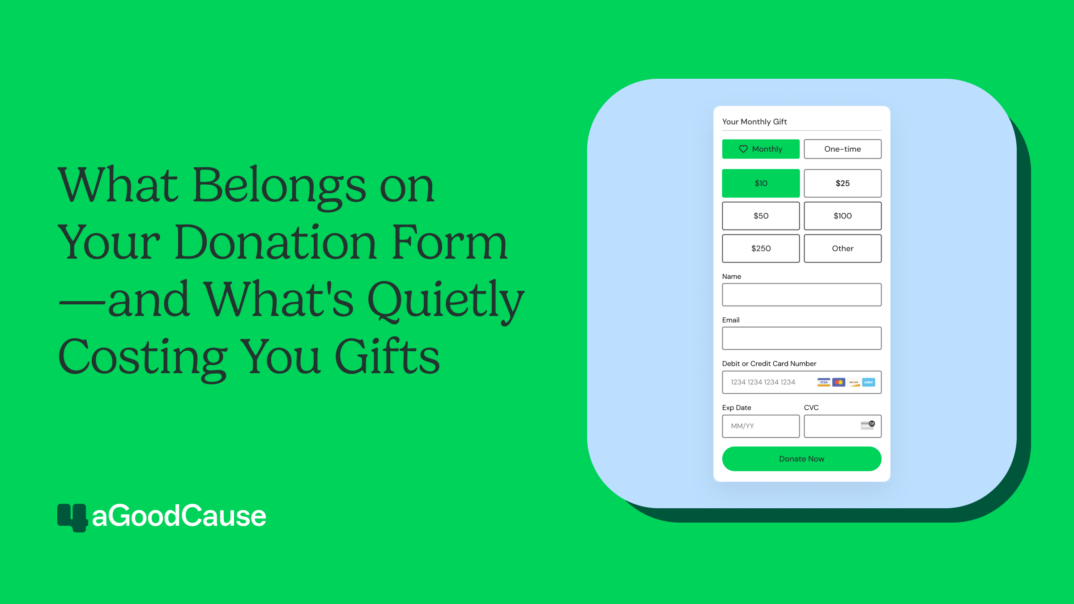
Let’s start with the basics. When a donor lands on your giving form, the goal is simple: get them to complete the donation process with as little friction as possible. That means your required fields should only include what’s actually necessary to process the gift and send a meaningful follow-up.
Here’s what every nonprofit donation form genuinely needs:
First name and last name are essential. You need the donor’s name to personalize thank-you messages, maintain clean donor data in your CRM, and build a real relationship over time. That said, fields like “title” or “salutation” (Mr., Mrs., Dr.) are optional at best—skip them.
Email address
Email is the primary way you’ll follow up, send tax receipts, and stay connected with your donors. It’s non-negotiable. Phone number, however, is a different story—more on that in a moment.
Gift amount
Your donation form should make it easy for donors to choose their gift amount. Offer suggested donation amounts (giving levels) that reflect what a meaningful gift looks like for your mission, plus a custom amount option for donors who want to give something different.
If you’re running a recurring giving program, your giving options should also include a clear path to set up a recurring gift.
⭐️ Want an easier way to maximize donations?Monthly giving generates 2.4x more revenue on average than one-time gifts, and our Monthly Giving Toolkit can help you get started. You can also learn more through our resources on the benefits of monthly giving for nonprofits and how to retain monthly donors.
Payment information
Your giving form should accept credit cards and debit cards at minimum. Offering additional payment methods—like ACH bank transfers or PayPal—can reduce friction for donors who prefer those options. Whatever payment processor you use (Stripe, Authorize.net, or a built-in option like 4aGC payments), make sure your form is PCI-compliant and clearly signals that their payment details are secure.
💡 Fun fact:All donor tips through 4aGoodCause go directly to your organization—not the platform. Learn what makes 4aGC different than other fundraising platforms, and explore our guide to monthly donation forms for nonprofits for more ideas on creating a stronger giving experience.
A recurring gift option
If your nonprofit doesn’t have a monthly giving program yet, this is your sign to start. A simple toggle that lets donors convert a one-time donation into a recurring donation is one of the highest-leverage things you can add to your giving form. Monthly donors have an average retention rate of 83.6%—compared to just 45.2% for one-time donors—and they give significantly more over time.
See how much you could raise with monthly giving!
How much can you earn?
$
Total raised for your organization
What fields can you safely cut from your online donation form?
This is where the original research behind this article still holds up—and then some.
Here’s what the data says: HubSpot studied 40,000 customer landing pages and found that conversion rates improved by nearly 50% when the number of form fields dropped from four to three.
That’s a single field making a measurable difference.
Here are the fields you can confidently remove from most nonprofit donation forms:
Phone number: On 4aGoodCause, this is a standard field, but it’s always optional. This field isn’t necessarily needed to process a gift or send a tax receipt. Making it optional can noticeably improve your completion rates.
Title or salutation: Mr., Mrs., Dr.—donors don’t need to fill this out to make a gift, and most won’t miss its absence. Drop it.
Company name: For most small nonprofits, the vast majority of donations come from individuals, not corporations. Unless you’re actively running a corporate giving campaign, there’s no need to include this field on your standard giving form.
“How did you hear about us?” This is valuable information—but your analytics tools, UTM tracking codes on emails and social media posts, and post-donation surveys can tell you the same thing without adding a field that slows down the donation experience.
Mailing address: Unless your state requires a mailing address for tax receipts or you’re sending physical acknowledgment letters, this is usually optional. Email confirmation handles most of what a mailed receipt used to do.
Date of birth: Not relevant for most online fundraising scenarios. Skip it.
Secondary email: One email address is enough at the point of giving. Collect additional contact information later.
Detailed demographic information: Some organizations collect data like age range or household income. If you need this for grant reporting, consider collecting it through a separate survey after the donation is complete—not as part of the giving process.
Trimming extra fields does more than clean up your form and can have a real impact on whether donors follow through.
“
What is the best price, with the most features, with the least work, and the best service? That's 4aGoodCause for us.
Dave Andrews
Station Manager at KJOL
Raise more with less effort.
See the fundraising platform that averages as 27% donor conversion rate.
On the flip side, a donation page built with fewer, more intentional form fields—combined with clear giving levels, trust signals, and mobile-friendly design—can perform dramatically better.
We see it across our 4aGC clients. According to the M+R Benchmarks Study, the average nonprofit donation page converts at 11%, but donation pages on 4aGoodCause convert at 27% on average, which is more than 2.45x the industry benchmark.
A/B testing your own donation form is also worth the effort. (And unlimited campaigns with 4aGoodCause makes this easy.) Test one variable at a time—like removing a field, adjusting your suggested donation amounts or impact statements, or changing the copy on your donation button—and let the data guide your decisions.
Small, informed changes to your giving form can have a compounding impact on your fundraising results over time.
Your organization’s logo, color scheme, and consistent fonts should appear on your donation page.
Branded donation pages and branded experiences build trust. A generic-looking giving form can create doubt about where their money is going.
Mobile-friendly design
Plenty of traffic to nonprofit donation pages comes from mobile devices and smartphones. If your form isn’t fully optimized for mobile, you’re losing donors who are ready to give right now.
A truly mobile-friendly donation form adjusts layout automatically, keeps input fields easy to tap, and loads quickly on any screen size.
Clear, suggested donation amounts
Donors often don’t know what a “typical” gift looks like. Giving levels with suggested amounts remove that uncertainty and often nudge donors toward higher gifts.
The average one-time donation on 4aGoodCause is $281—more than double the industry average of $126. Part of that difference comes from thoughtfully designed gift options that guide donors toward meaningful giving amounts.
A recurring gift pop-up or toggle
One of the most effective features in 4aGoodCause is a built-in monthly giving pop-up that appears after a donor selects a one-time donation amount.
On average, this pop-up converts at 5%—meaning 2 to 3 in 50 one-time donors upgrade to a recurring gift without any extra effort from your team.
The average monthly donation is $24, while recurring gifts on 4aGoodCause average $55 per month.
That’s donor retention happening automatically.
⭐️ Ready for more consistent donations with less planning hassle?Monthly givers have an 83.6% retention rate. See how 4aGoodCause helps you build a loyal base of recurring donors—and explore how to accept monthly donations and monthly giving program examples.
Secure payment signals
PCI-compliant payment processing and visible security badges reassure donors that their payment information is safe. Whether you use Stripe, Authorize.net, ACH, or a built-in payment processor like 4aGC payments, your donation form should clearly signal that the giving process is secure. If donors have any doubt about security, they won’t complete the gift.
Immediate thank-you messages
The first thank-you should appear automatically on the donation confirmation page—right after the donor completes the form. From there, an automated email should follow with a tax-acknowledgment and a warm, personal message. These moments matter for donor retention and set the tone for a long-term relationship.
The good news is that simplifying your donation form doesn’t mean losing valuable donor insight—it just means collecting it more thoughtfully.
“
4aGoodCause has been a game-changer for our organization. What really sets them apart is how flexible and customizable the platform is to your organization’s specific fundraising, donor management, and campaign needs. Instead of forcing nonprofits into a one-size-fits-all system, 4aGoodCause helps create solutions that actually fit the way you operate.
Cristina T.
Executive Director at Steelworks
How do you collect donor information you still need?
Cutting fields from your donation form doesn’t mean you’re giving up on understanding your donors. It just means you’re collecting that information at a smarter point in the relationship.
Here are some practical ways to gather the data you need without cluttering your giving form:
Post-donation surveys: Send a short survey in your follow-up email. Donors who have just completed a gift are in a good mindset and often willing to share a bit more about themselves.
Fundraising events and peer-to-peer fundraising: In-person interactions are a natural opportunity to collect contact information, phone numbers, employer details for matching gifts, and more.
Your CRM: Over time, your fundraising platform and donor CRM will build a rich picture of each donor through their giving history, email engagement, and other touchpoints. You don’t have to collect everything on day one.
Social media and email outreach: Use your social media presence and email newsletter to invite donors to share more about themselves through preference centers, surveys, or simply by replying to a message from your team.
Of course, knowing best practices is one thing—having them built into your donation form from the start is even better.
What if your donation form already had the best practices built in?
Most donation page best practices take time to research and implement on your own.
At 4aGoodCause, we built nearly 100 of those best practices directly into our donation form templates—so your giving form starts optimized, not just functional.
Nonprofits using 4aGoodCause see:
Average conversion rates around 27% (vs. 11% industry-wide)
Average one-time gifts of $281 (vs. ~$126 industry average)
Average recurring gifts of $55/month (vs. ~$24 industry average)
Some of our clients’ campaigns convert even higher, with top-performing pages reaching 75%+ conversion rates.
⭐️ Fundraising software that feels like part of your team.
4aGoodCause is an intuitive platform for both our team and our donors. The donor experience is seamless, and the reporting tools give us the insights we need without being overwhelming. The customer support has also been exceptional—quick, personal, and genuinely invested in our success.
Lily Lombardi
Donor Relations, Manos de Cristo
Ronald Pruitt
Ronald is the President and Founder of 4aGoodCause, the fundraising CRM that makes recurring, monthly giving a breeze for small nonprofits.
For over 25 years, Ronald has had the joy of doing what he loves, building online solutions that make a difference in the world. He’s helped raise millions of dollars online for small nonprofits across the country. Connect with Ronald on LinkedIn.
Grow your monthly giving program with our resources